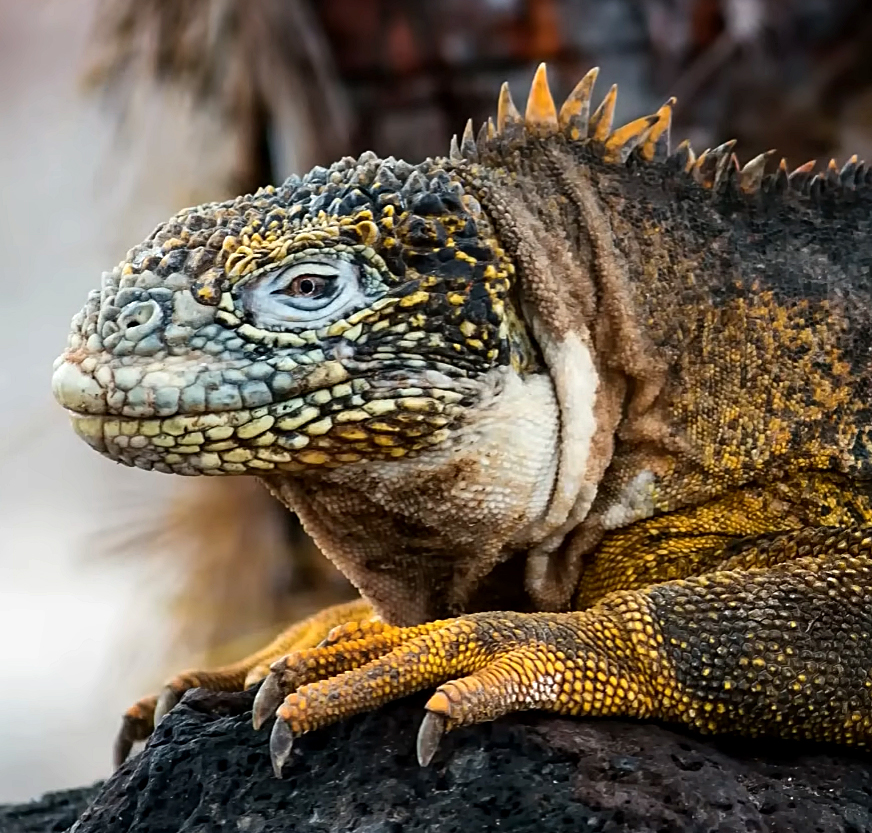
The Galápagos Islands in the Pacific Ocean frequently serve as a live exhibit of evolutionary processes. These islands house distinctive fauna not present anywhere else globally, attracting scholars, environmental advocates, and eager visitors for many years. Upon his arrival in 1835, Charles Darwin was amazed by the rich variety of life forms observed here.
However, this natural haven also harbours a grim narrative – one involving international wildlife trafficking, legal gaps, and an illicit trade that endangers some of the world’s most recognisable reptilian species.
The target species? The Galápagos land iguana ( Conolophus subcristatus ), pink land iguana ( C. marthae Barrington Land Iguana C. pallidus and marine iguana ( Amblyrhynchus cristatus ) that feed on submerged algae. The four species are native to the Galápagos and are rigorously protected under Ecuadorian legislation.
Nevertheless, even after years of both local and global protections, these creatures end up with collectors of exotic pets globally, equipped with falsified documents and assertions of captive breeding, as pawns in a sophisticated trafficking scheme.
[caption id="attachment_2671839" align="alignnone" width="1906"] The specific type of iguana aimed at. (Photo: Galápagos Conservancy) [/caption]
Legal gaps
The Convention on International Trade in Endangered Species of Wild Fauna and Flora (CITES) was created to manage and, if needed, prohibit the global exchange of endangered animals. These species are categorized into various appendices; Appendix I provides the highest level of protection. The four types of Galápagos iguanas are included in Appendix II. This appendix allows for trading as long as they have been bred in captivity and their lawful acquisition can be verified.
What’s wrong? People are finding ways to manipulate the system.
According to a report Created by a worldwide group of 20 conservation experts, the tactic employed by smugglers involves passing off wild-caught iguanas as captively-bred through an international shell game wherein these animals are moved between countries to avoid regulations.
Animals caught in the wild are transported to a transit nation—often one with lax regulation—which allows them to be incorrectly labeled as being bred in captivity. With this false classification, these creatures become eligible for legal trade under CITES regulations. This enables illegal traders to then supply these animals to wealthy buyers located across Asia, Europe, and North America.
In 2010, Mali, Switzerland, and Uganda became significant points within this network. During that year, two pink land iguanas along with two regular land iguanas were transported from Mali to Switzerland, all movements being conducted under CITES permissions.
Despite having no documentation of lawful entries into Mali or signs of breeding operations, all four creatures were marked as captively bred. In 2014, Switzerland then provided CITES export permissions for these animals destined for Uganda, thus finalizing the paperwork needed to seemingly legitimize their transaction.
[caption id="attachment_2671837" align="alignnone" width="1801"] Iguanas are ending up with exotic collectors globally through a sophisticated smuggling operation involving falsified documents and false statements about them being captive-bred. (Image: David Clode / Pixabay) [/caption]
Trafficking hub
As stated in the report, Uganda has emerged as the leading global supplier of captive-bred Galápagos land iguanas, with numerous specimens being transported to nations such as Japan, Thailand, Indonesia, and South Korea.
It goes without saying that Uganda does not have any indigenous iguanas, nor does it have a historical breeding program or allow legal imports of founding specimens. Given these facts, how did the nation manage to turn into a legitimate source for some of the most uncommon reptiles on our planet?
At the core of this trade lies the Ugandan Conservation Through Commercialization (CTC) Center, a privately owned facility located in Lusaka. The center’s director, Thomas Price—a Swiss national—oversees its operations. reported to have a previous conviction in New Zealand for reptile trafficking. Daily Maverick reached out to the center two weeks ago seeking comments, but did not receive a response by the time of publishing.
The establishment asserts that it breeds Galápagos iguanas; however, no credible information has been released to support this claim, leaving the source of these animals unclear. Legally owned iguanas outside Ecuador are solely found at the Charles Darwin Research Station and Galápagos National Park, where they are maintained for preservation purposes rather than trade.
Furthermore, a consignment shipped from Sudan to China in 2019, claiming Uganda as the source country, went unreported by Uganda altogether. This oversight underscores inconsistencies and possible intentional omissions within CITES documentation.
[caption id="attachment_2671838" align="alignnone" width="1808"] Uncommon iguanas manage to last for some time, however, they typically do not have long lives when kept in captivity. (Image: Ulrike Mai / Pixabay) [/caption]
Smuggler snapshots
Although documents may be altered, social media entries provide a more spontaneous insight. windows into this illicit world.
In 2012, a man from Switzerland shared a picture on Facebook showing marine iguanas in his possession—creatures not meant for private ownership. The following year, he uploaded an image of a land iguana as well. By 2014, Switzerland granted him a CITES permit allowing the exportation of these reptiles to Uganda, thus legitimizing their status through official channels.
In another instance, a person from Thailand shared online in 2022 that their iguanas were "ready for offspring" on the Galápagos Islands, encouraging potential purchasers to get in touch. Several weeks afterward, images surfaced showing this individual in Uganda alongside the head of the CTC Center and an infamous German wildlife dealer. Such associations highlight the intricate, international character of the trafficking operation.
On YouTube, a reptile dealer in Indonesia posted an " unboxing video featuring four young Galápagos land iguanas transported from Uganda — presumably among the 64 iguanas that were officially exported by the nation since 2017.
Cover story
CITES Resolution 18.7 mandates that exporting nations confirm the lawful procurement of breeding stocks prior to granting permissions for farmed creatures. However, in practice, numerous regulatory bodies either fail to enforce this properly or, even more troublingly, issue permits without conducting thorough checks.
This opens up a perilous gap: Smugglers can hunt endangered species, pass them off through an accommodating or compromised intermediary nation, and subsequently claim their young were born from legal breeding programs. With proper documentation in place within the trading network, diligent importing nations might find it challenging to refuse entry or track these animals accurately.
Ecuador, which remains the sole nation home to wild colonies of Galápagos iguanas, has never Issued commercial CITES export permits for the species. However, animals are still showing up in trade – legally.
Cracks in the system
Multiple enforcement measures and CITES resolutions highlight increasing worry. In 2020, the European Union’s Scientific Review Group provided a Negative Opinion, prohibiting the importation of Galápagos iguanas from all countries. In 2022, Ecuador presented a paper to the CITES Standing Committee, criticizing the persistent illicit trading activities and the deceptive application of breeding-in-captivity assertions.
Yet the trade continues.
In June 2022, officials from Ecuador took action intercepted A delivery containing five land iguanas and 84 giant tortoises was sent out. Previous years saw apprehensions on these islands concerning smugglers from Germany and Mexico. Each case indicated Uganda as the intended final stop for these creatures. However, neither Uganda nor Switzerland have faced repercussions for aiding this trafficking activity. Additionally, CITES hasn’t upgraded these species to Appendix I status, which would entirely ban any form of commercial exchange. DM
What needs to happen
The report’s writers urge multiple immediate steps:
- Suspend all global commerce involving Galápagos iguanas until lawful procurement has been confirmed;
- Relocation of all four iguana species to CITES Appendix I, indicating their endangered status and Ecuador’s stringent export regulations;
- Cancellation of current export permits granted by Mali, Switzerland, and Uganda along with seizure of creatures lacking evidence of legitimate origins; and
- Development of a gene repository to assist authorities in tracking down the source of confiscated wildlife.
The journalist aims to highlight that this case extends beyond the Galápagos Islands. It underscores a larger issue within the wildlife trade sector: legal systems that can be readily exploited, sporadic law enforcement, and an international demand for exotic creatures that continues to grow unabatedly.
So long as creatures such as the Galápagos iguanas can become living trophies for individual collectors, smugglers will discover methods to meet this demand.
At present, within secluded facilities distant from their homeland islands, these uncommon iguanas manage to endure temporarily. However, typically, they do not last very long when held captive. Their path is fraught with deceit, financial gain, and the breakdown of a protective framework designed to shield them.