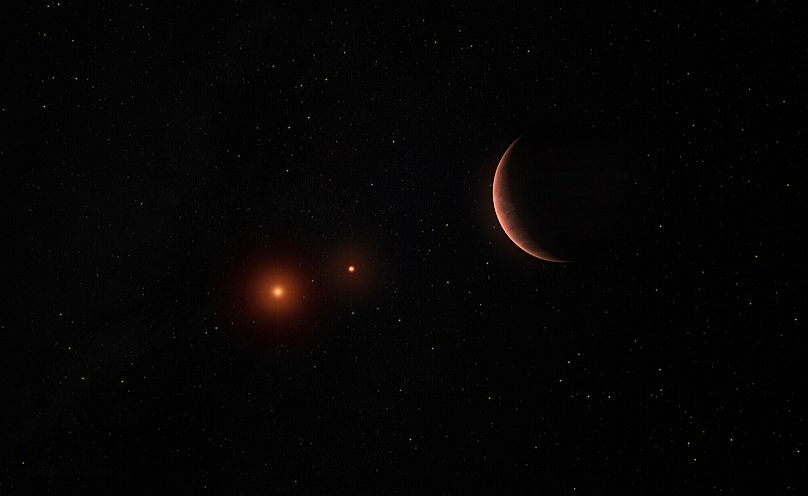
Scientists have detected potential indicators of life in the atmosphere of a far-off planet beyond our solar system; however, they stress that additional research is necessary to validate these observations.
The study, headed by researchers from the University of Cambridge, found signs of substances in the exoplanet’s atmosphere that on our planet are exclusively created by living entities, marking it as the most robust possible indication of life discovered so far.
Independent researchers deemed the discoveries intriguing yet insufficient to prove the presence of life on another world.
"The most robust indication so far of potential biological activity beyond our solar system," stated Cambridge astrophysicist Nikku Madhusudhan during an online stream on Thursday.
Through an analysis of information gathered by NASA along with the European Space Agency’s James Webb Space Telescope, scientists discovered indications of dimethyl sulfide and dimethyl disulfide present in the environment surrounding the exoplanet named K2-18b.
On our planet, these two compounds are mainly generated through the activity of microscopic organisms like marine phytoplankton.
This planet exceeds Earth's dimensions by over twice its size and possesses a mass greater than eight times that of Earth. Additionally, it resides within what astronomers refer to as the habitable zone around its star.
It lies at a distance of 124 light-years from us. A single light-year spans almost six trillion miles.
Madhusudhan emphasized that additional studies are necessary to eliminate any potential mistakes or the chance of other mechanisms, apart from living entities, that might generate these compounds.
David Clements, an astrophysicist based at Imperial College London, stated that atmospheres of other worlds are intricate and challenging to comprehend, particularly when studying them using only the scant data obtained from such distant celestial bodies.
"These findings are truly intriguing, even though they haven’t yet confirmed the presence of dimethyl sulphide and dimethyl disulphide. Nonetheless, this research marks progress towards that goal," he stated in remarks provided by the Science Media Centre in London.
So far, over 5,500 planets orbiting distant stars have been verified. Additionally, thousands more potential exoplanets are awaiting confirmation among the billions within our Milky Way galaxy alone.
Introduced in 2021, Webb is the largest and most advanced telescope ever dispatched to space.