- READ MORE: Harvard researcher claims Mars once hosted an advanced society destroyed by a nuclear conflict
NASA has acknowledged the existence of a crater wider than 300 feet on the surface Mars might serve as a gateway to an hidden realm of extraterrestrial existence .
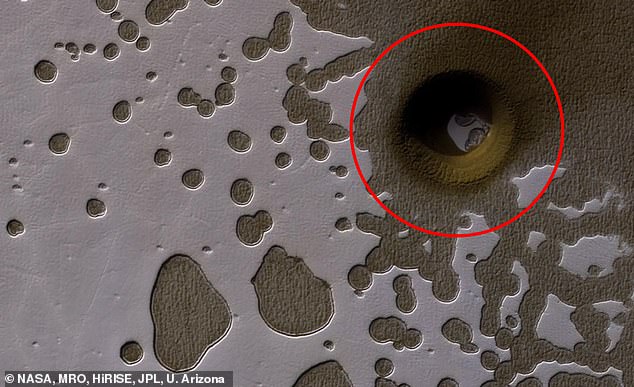
The U.S. space agency released the startling picture of a massive opening on the Martian terrain on Sunday for its Astronomy Picture of the Day.
Instead of leaving people with a mystery, NASA suggested that the large crater seems to open up into what looks like an underground passage. mysterious 'lower level' that may support life.
'Craters like these are especially intriguing since they could serve as gateways to deeper layers that lead to extensive subterranean caverns,' stated NASA scientists.
'Thus, these naturally formed tunnels offer significant protection against the extreme conditions on Mars’s surface, which makes them quite suitable as potential habitats for Martian life,' they noted.
It's quite a statement by NASA, which has consistently tried to manage the public's expectations of finding extraterrestrial life both on other planets and here on Earth.
Up until now, the emphasis has been on microbial life that might be concealed within the icy seas of Earth's adjacent planets and their moons.
Nonetheless, researchers pointed out that there might be 'extensive subterranean caverns' on the opposite side of this opening, suggesting that this region could potentially turn into a key destination for upcoming astronauts touching down on Mars .
NASA highlighted that this picture, captured in 2017 by the Mars Reconnaissance Orbiter, reveals multiple depressions on the Red Planet’s terrain.
The researchers describe an image featuring many cavities reminiscent of Swiss cheese, where almost all these hollows reveal a dusty, dark Martian surface underneath evaporating thin layers of light carbon dioxide ice. wrote .
The most prominent feature in the satellite image is the nearly circular depression located at the top right, which measures approximately 328 feet across – essentially forming a huge hollow space.
Adding to the mystery is the presence of a round crater encircling this opening as well.
Regarding the cause, the NASA team hypothesised that it might have resulted from a meteor strike, yet the more pressing query today revolves around what lies at the bottom of this hole.
'Thus, these craters are also ideal spots for potential upcoming missions involving spacecraft, robots, and even human interplanetary explorers,' NASA further noted.
Even though scientists think Mars may have been more similar to Earth billions of years back, the highest chance of discovering evidence of life now depends on NASA's rovers, satellites, and upcoming astronauts. unearthing hidden caverns or lava tunnels beneath Mars' ancient exterior .
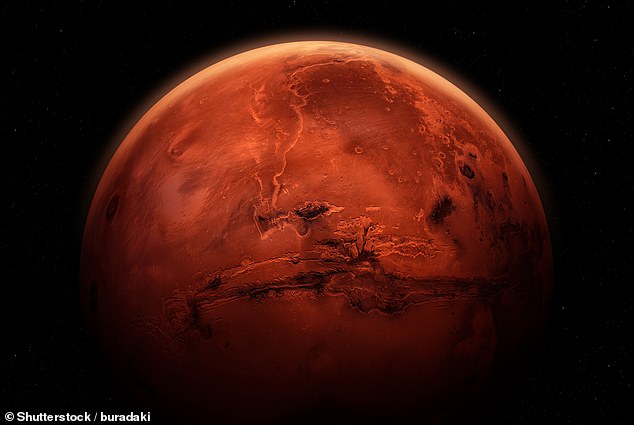
Given that Mars currently does not have a robust magnetic shield or dense atmosphere, its surface is continually exposed to intense cosmic and solar radiation, potentially lethal to known forms of life.

Nevertheless, life could potentially endure beneath the surface due to the inherent protection offered by these caverns and tunnels—suggesting that astronauts might discover signs or perhaps even fossils indicative of past biological activity in such locations.
South Africa's specialists in hidden subterranean phenomena and earth movements - the United States Geological Survey (USGS) was called upon to locate these caverns.
In 2019, the USGS Astrogeology Science Center disclosed a stunning map outlining more than 1,000 potential sites identified by their specialists as possible caves on the Martian terrain.
Sadly, the USGS mentioned that their assessment relied on information received from probes orbiting 250 miles above Mars' surface.
Glen Cushing, a space scientist at the USGS Astrogeology Science Center, stated: "It is not possible to determine how deep any of these features penetrate under the surface."
He clarified in the 2019 publication that they cautiously refer to these as 'potential' cave entries due to uncertainty distinguishing between actual caves and smaller recesses.
Various space missions, such as the European Space Agency’s Mars Express, have likewise uncovered signs of old lava tubes under the Red Planet’s inactive volcanoes.
Nevertheless, this recently unveiled image unequivocally shows that there is at least one opening on Mars leading to some mysterious underground stratum.
The earliest humans astronauts might get to witness this massive crater with their own eyes would be in 2028.
Elon Musk, the founder of SpaceX, recently made an appearance on The Joe Rogan Experience podcast, during which he quickly sped up the schedule for humans reaching Mars.
Earlier, the objective was to achieve the first manned mission to land humans on Mars by 2030 at the soonest .
Musk stated that SpaceX's 'primary strategy' was to 'send multiple Starships to Mars towards the end of the following year.'
These are similar to the spacecraft that SpaceX has been experimenting with; some of these trials have concluded in a fiery explosion .
These missions would similarly not carry any crew members and aim to verify whether the spacecraft can successfully touch down on the Red Planet. Musk further mentioned that he anticipates SpaceX will dispatch around five unmanned vessels to Mars in 2026.
Read more