Last year witnessed the highest increase in atmospheric carbon dioxide levels since records began, a sharp rise that has alarmed experts who worry this might signify that Earth’s ecosystems, strained by rising temperatures, have become less capable of absorbing human-generated pollutants.
On Monday, the National Oceanic and Atmospheric Administration’s Global Monitoring Laboratory revealed data indicating that the levels of carbon dioxide in the atmosphere surged by 3.75 parts per million in 2024. This leap is 27% greater than the former highest increase recorded back in 2015, pushing the atmospheric CO₂ concentrations to a point unseen for at least three million years.
Although most greenhouse gases stem from the combustion of fossil fuels by humans, a new study published on Tuesday indicates that the sharp increase observed last year may have been primarily caused by another factor: the decline of rainforests and other terrestrial ecosystems due to rising global temperatures.
Amidst what researchers report as the warmest year on record, an increase in atmospheric CO2 levels suggests that humankind might be losing a vital partner in combating global heating, according to specialists. Historically, both lands and seas have absorbed approximately fifty percent of the greenhouse emissions produced by humans. If not for these natural absorbers of CO2—referred to as carbon sinks—the Earth’s average temperature could potentially soar double the current level of around 1.3 degrees Celsius (about 2.3 degrees Fahrenheit), which we've already experienced.
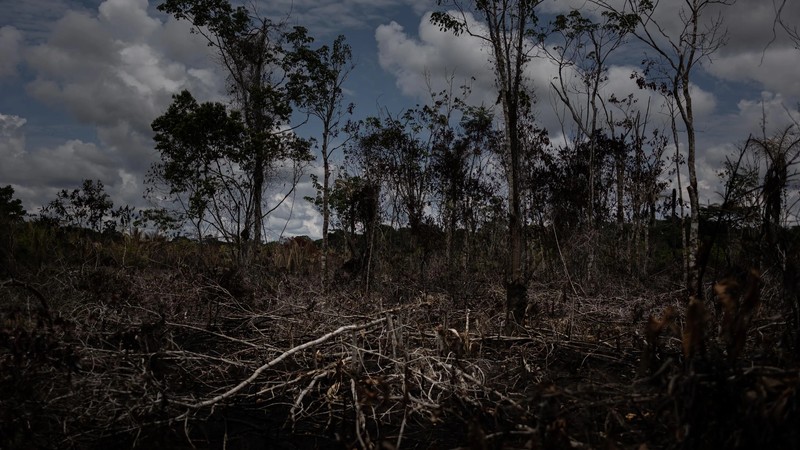
The initial assessment released on Tuesday reveals that severe droughts and intense wildfires led to substantial releases of carbon from forests last year, essentially negating whatever emissions these areas could have sequestered. Although not definitive, this data has raised worries among researchers monitoring the accumulation of greenhouse gases over time.
"What this indicates is that climate change is actually affecting the land-based carbon sink," stated John Miller, a carbon cycle scientist at the Global Monitoring Laboratory.
The quest for a source
Each week, monitoring stations operated by NOAA from locations such as Hawaii to the South Pole collect atmospheric samples focusing on carbon dioxide along with various other gases. When these global measurements are compiled together, scientists can ascertain the percentage of the atmosphere occupied by heat-trapping pollutants and also gauge the rate at which this concentration is escalating.
The agency forecasts for 2024 indicate that the increase in CO2 levels accelerated by over 30 percent compared to the prior year.
This represents an unprecedented level," stated Glen Peters, whose research focuses on the carbon cycle at the CICERO Center for International Climate Research in Norway. "This prompts the question: 'Why is it significantly higher than anticipated?'
Data indicates that rapid increases cannot simply be attributed to burning fossil fuels alone. Although emissions from coal, oil, and natural gas reached their highest point ever last year, according to the International Energy Agency, this peak wasn't particularly extreme. In recent times, the expansion of fossil fuel pollutants has slowed down due to the decreasing costs and broader availability of renewable energy sources like solar and wind power. Early projections from the Global Carbon Project indicate that carbon dioxide emissions from fossil fuels grew approximately 0.8% in 2024 compared with the prior year—far too small to account for such a significant rise in greenhouse gases.
Researchers also do not believe that the increasing levels of carbon originated from the oceans, which typically absorb around 25% of human-generated pollutants. The movement of carbon dioxide generally occurs from the atmosphere into the ocean through phytoplankton absorption via photosynthesis or by dissolving directly into seawater; however, scientists have not noted substantial alterations in these processes so far.
Miller stated that the sole possible explanation left is a shift in how much contamination is taken up by terrestrial areas.
Researchers indicate that terrestrial carbon sinks are particularly susceptible due to their reliance on biological processes which vary significantly each year. Under favorable growth conditions, plants absorb vast quantities of carbon dioxide via photosynthesis. This captured carbon gets stored within plant structures like wood or becomes part of the soil, remaining isolated from the atmosphere for hundreds of years.
According to the Intergovernmental Panel on Climate Change, over the past ten years, forests and other terrestrial ecosystems have absorbed roughly 30% of the carbon released into the atmosphere through human activities.
These landscapes are being progressively altered by both human activities and natural events, according to Nancy Harris, who manages global forest research for the Global Forest Watch programme at the World Resources Institute. By employing satellite images along with various tracking technologies, Harris and her team have analysed how deforestation efforts or large-scale wildfires could release centuries’ worth of stored carbon within just 24 hours. Additionally, drought conditions might hinder plant growth through reduced photosynthetic activity, thus disrupting the process of absorbing atmospheric carbon. Furthermore, increasing heat levels can speed up soil breakdown, leading to higher emissions of CO₂ into the atmosphere.
From a self-centered human viewpoint, we've kept depending on these forests to offset our emissions," Harris stated. "Without this carbon sink to count on, climate change will become far more severe than it currently is.
Forest feedbacks
At the start of 2024, our planet was already experiencing a natural climate phenomenon known as El Niño, during which warm conditions in the Pacific Ocean typically cause global average temperatures to rise significantly.
Philippe Ciais, who serves as the associate director of the Climate and Environmental Sciences Laboratory near Paris, has indicated that El Niño phenomena have detrimental effects on land-based carbon storage. These occurrences typically reduce precipitation in tropical rainforests, notably within the Amazon region, which can result in an increase in carbon-releasing fires and hinder plant development.
On Tuesday, a preliminary study posted to the preprint server arXiv detailed work conducted by Ciais and Peters alongside a group of international scientists. They examined the flow of carbon during the recent El Niño period, approximately between July 2023 and June 2024. Despite this analysis yet being unpublished in an academic journal, they employed robust methodologies previously vetted through peer review to monitor carbon movement across the atmosphere, seas, and terrestrial areas.
Utilizing information provided by the European Centre for Medium-Range WeatherForecasts (ECMWF), researchers discovered that the arid conditions in tropical rainforests extended far beyond what had been observed during earlier El Niño events. At its peak, almost one-third of theAmazon region sufferedfrom severe drought.
By employing various international vegetation models along with information from NASA’s Orbiting Carbon Observatory satellite, which tracks atmospheric CO₂ levels, scientists calculated that over a year span, terrestrial areas absorbed roughly 2.24 gigatons less carbon than expected—comparable to the amount released by combusting approximately 9 billion pounds of coal.
Based on the method used for calculation, this adjustment either eliminated the positive contribution from the land sink entirely or transformed terrestrial ecosystems into a net producer of carbon emissions.
"This tropical aridity is essentially halting CO2 absorption," Ciais stated.
The analysis only goes up until June, after which time the El Niño was announced as ended. However, the scientist mentioned that he had growing concerns about subsequent developments.
Although the conclusion of the climate phenomenon usually marks the return of humidity, during the latter part of last year, the severe drought in the Amazon intensified, affecting almost 40 percent of the rainforest. Throughout South America, numerous rivers reached their lowest points ever recorded. Blazes tore across the dry terrain, consuming an expanse bigger than that of California.
Across the Atlantic, central African rainforests faced similarly intense dryness. Data from the ECMWF indicated that over fifty percent of this area encountered "extreme" circumstances by mid-summer. Satellite observations revealed that these forests were reflecting significantly higher levels of solar radiation compared to usual—a sign suggesting tree deaths or excessive stress impairing their ability to carry out photosynthesis.
It's a poor mix of an El Niño followed by a highly intense dry spell, leaving the plants with no respite," Ciais stated. "This scenario has not been seen before in past El Niño occurrences.
The reasons behind the intense suffering of the world’s forests last year remain obscure. This situation might simply be due to unfortunate circumstances—a powerful El Niño coinciding with a random occurrence like a drought. Alternatively, this could indicate the start of a climate feedback mechanism where increasing temperatures lead to higher carbon emissions, causing global warming to escalate even more.
The clear question is: Are we approaching a turning point in natural ecosystems?" asked Rob Jackson, a climate scientist at Stanford University’s Woods Institute for the Environment. "One year's increase doesn't settle this issue, so I'm not claiming we have reached such a stage; however, that thought crosses my mind.
Scientists are continuing to gather information on last year’s emissions and eagerly awaiting the impact on our atmosphere come 2025. However, the previous year ought to serve as an alarm regarding the consequences of persistent planet-heating contamination, according to Miller. So long as humans keep releasing greenhouse gases, temperatures will persistently climb, bringing us incrementally nearer to potentially unlocking the carbon locked within the Earth.
We're quite lucky to have these chemical and biological systems that absorb much of our emissions, but this isn’t guaranteed," Miller stated. "The year [2024] illustrates this point.