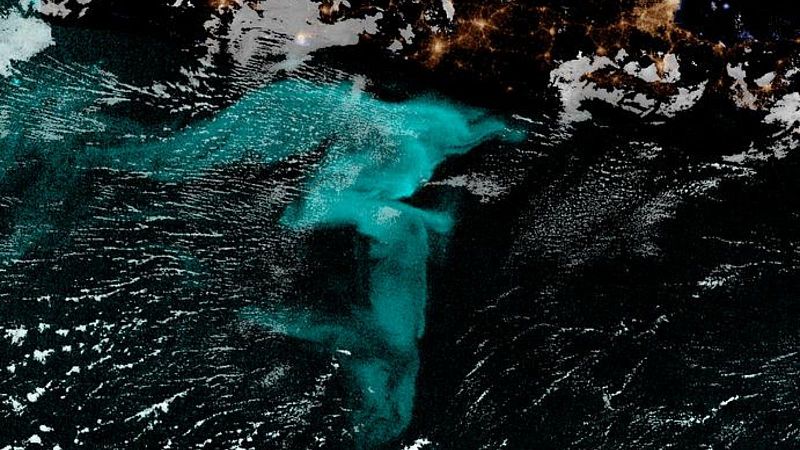
"The entire surface of the sea resembled a field blanketed with snow. The sky had barely a wisp of clouds, but it seemed as dark as though a tempest was brewing." This observation was made by a sailor in 1854 when he encountered the unusual occurrence known among mariners as 'milky seas'.
These luminous marine occurrences have perplexed humanity for hundreds of years. The "dreadful magnificence" that a nineteenth-century mariner recounted – which led him to believe the end was near – is something we currently understand as a type of phenomenon. bioluminescence Light produced by living creatures through chemical processes within their bodies.
However, this marine luminescence remains enigmatic. In an attempt to comprehend this occurrence, scientists in the United States have developed a database that merges 400 years of mariners' observations with contemporary satellite information.
The CSU team along with the Cooperative Institute for Research in the Atmosphere claim that this development will assist research ships in predicting when and where a milky sea phenomenon might happen, allowing them to gather samples effectively.
"Phosphorescent seas represent remarkable manifestations of our biosphere, the full extent of their importance in nature remains undetermined," explains Professor Steven Miller, who is a co-author of a new study. study Regarding the database, "Their presence highlights undiscovered links between what happens at ground level and what occurs in the atmosphere, as well as the role of bacteria from tiny scales up to global levels within the Earth’s systems."
Thanks to this newly created database, which spans from seafaring vessels of the 17th century to contemporary spacecraft, we start constructing a link between folklore and scientific comprehension.
What causes milky seas?
Ranging from "snow white" to an intense "brilliant and bright green," and shifting from ghostly grey to turquoise, milky seas have appeared in numerous hues throughout history. These phenomena can span vast areas—sometimes exceeding 100,000 square kilometers—and persist for several weeks at a time.
This consistent luminescence sets them apart from other prevalent forms of watery light shows, such as the twinkling of plankton. Their size and brilliance are often visible even from outer space.
Milky seas are thought to result from bacterial action – probably originating from a glowing microorganism known as Prochloron-fontawesome-italic{Prochlorococcus}. Vibrio harveyi This particular strain was discovered residing on the exterior of algae during an algal bloom, when a research ship successfully collected a sample back in 1985.
However, since these milky shows happen infrequently and usually in distant areas, Indian Ocean , researchers have found it challenging to obtain the biological data to support this claim.
"It's extremely difficult to study something when you lack relevant data," explains Justin Hudson, a PhD student at CSU within the Department of Atmospheric Science and lead author of the paper.
He notes, 'There is just one known photograph taken at sea level, which resulted from a random meeting with a yacht in 2019.' He continues, 'Therefore, many aspects remain mysterious regarding when and why this occurs along with its effects on regions impacted by such phenomena.'
In what way are milky seas related to climatic occurrences?
The updated database indicates that sightings typically occur in the vicinity of the Arabian Sea and Southeast Asian waters. It further discloses a statistical correlation with the Indian Ocean Dipole phenomenon. El Niño The Southern Oscillation occurs as sea surface temperatures change.
As both of these climatic events have an influence on worldwide weather conditions, the scientists are eager to understand precisely how milky seas connect with these patterns.
"The areas where these occurrences happen most frequently are located in the northwestern part of the Indian Ocean close to Somalia and Socotra, Yemen, accounting for almost 60 percent of all recorded instances. Additionally, we understand that the different stages of the Indian monsoon influence biological activities in the area via alterations in wind patterns and ocean currents," explains Hudson.
It appears plausible that milky seas might be an under-researched component of the extensive circulation of carbon and nutrients within the Earth’s systems. This likelihood grows stronger as our knowledge expands regarding the crucial function bacteria play in these global processes. carbon cycle Both on terra firma and in the sea."
He points out that areas where milky seas happen exhibit high levels of biodiversity and hold considerable economic importance for fisheries—indicating substantial local impacts as well.
"We have no understanding of what milky seas signify for the ecosystems where they occur," notes Miller.
"They might signify either a thriving ecosystem or a troubled one—the bacteria we believe are responsible can have adverse effects on fish and crustaceans," he explains.
By having this information prepared, we can start addressing inquiries regarding milky seas without merely relying on the chance of a vessel stumbling upon one inadvertently.