
- EXPLORE FURTHER: Mysterious 'Gateway' Found on Mars by NASA
For many centuries, the hunt for beings from outer space has stood out as one of the most significant pursuits in science.
Now, scientists might have just made a significant leap forward in the quest to discover life beyond our planet. solar system .
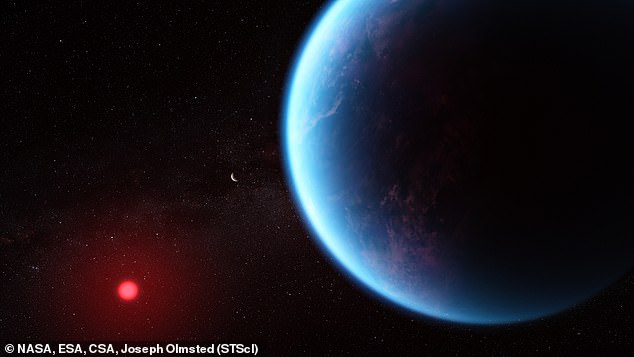
Planet K2-18b – larger than our planet by over two times and located at a distance of 120 light-years – resides within the livable region around its star in the Leo constellation.
Encouragingly, analyzing its atmosphere uncovered large amounts of chemicals, which can only be produced by living things .
This represents the 'most compelling evidence so far' of life beyond our solar system, according to specialists who view this as a 'significant, groundbreaking development.'
However, if aliens If such individuals do exist, it could be a significant error to attempt contacting them, as per the experts.
Mark Buchanan, who is a physicist and science writer based in the UK, has stated contact with aliens might lead to 'the extinction of all life on our planet.' .
"I believe it would be quite unwise to simply initiate contact without first attempting to gather more information about the other civilization," he said to MailOnline.
'A significant argument exists amongst researchers regarding whether we should proactively send communications towards possible civilizations, since these entities might turn out to be unfriendly and could possess incomprehensibly greater power compared to ours.'
'Traditionally, whenever various civilisations encountered each other on Earth, the outcome frequently led to the annihilation or subjugation of the less powerful faction.'
However, some individuals have differing opinions and contend that perhaps an alternate society might impart knowledge to us, like better ways to handle our scarce ecosystem or share novel technologies—thus, intriguing concepts can be found on either side of the argument.
Researchers can transmit communications toward a different star system. In radio or light transmissions, similar to conveying data through an email over the internet. .
Buchanan suggests that the most effective method for making contact with extraterrestrial beings would be to transmit light signals toward their planet due to their rapid speed of travel.
"And there are numerous methods to transmit signs of a type that remain unaltered by any natural process, allowing another civilization to recognize them as originating from an intelligent source," he explained to MailOnline.
Buchanan emphasizes that these possible organisms on planet K2-18b are probably "some form of microbial life, rather than an advanced civilization."
Dr. Anthony Milligan, an ethicist from the Department of Theology at King's College London, stated that if we were to discover intelligent extraterrestrial life, "there would be an irresistible desire to make contact."
Dr Milligan explained to MailOnline: "However, we must remain vigilant regarding the data we transmit — primarily due to planetary safety concerns, but chiefly because we fear inadvertently causing harm elsewhere by sending incorrect information."
'Sincerely meant interactions don’t always turn out fine. Such engagements could be beneficial, yet we should move forward cautiously.'
Professor Avi Loeb, a theoretical physicist from Harvard University, stated that if humanity definitively discovers life on an exoplanet, we should certainly tune into any technological transmissions it sends out—though he noted these interactions could pose significant challenges.
'The exoplanet K2-18b is located at a distance of 124 light years from Earth,' he stated for MailOnline.
If we transmit a communication signal immediately, the soonest we could expect a reply, traveling at the speed of light, would be 248 years later, reaching us in the year 2273.
I'm not particularly patient and I'd prefer to study this closely, watching every detail for centuries leading up to the year 2273.
Prof Leob mentioned additionaly, "It is likely that aliens would not see us as a significant threat."
Actually, what worries me is that they might ignore any direct messages we send since they probably won’t consider us very smart due to the geopolitical situation on our world.

Buchanan referred to the recent declaration from researchers as a 'captivating discovery,' indicating that it points towards 'the existence of more sophisticated life forms in other parts of the cosmos.'
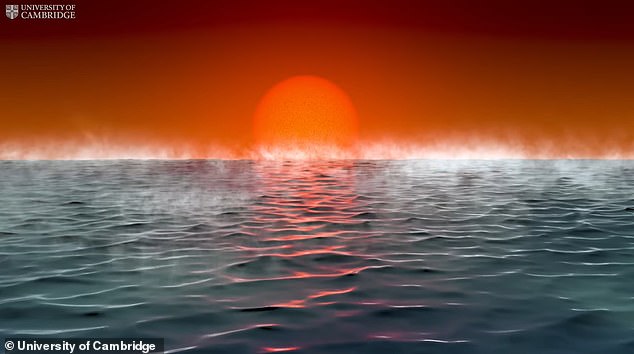
Research on the exoplanet K2-18b is spearheaded by Dr Nikku Madhusudhan, an astrophysicist from the University of Cambridge. He has referred to this celestial body as a 'hycean' world—a planet composed largely of rock but featuring a thick atmosphere rich in hydrogen and vast bodies of liquid water.
The planet K2-18b – which has more than eight times the mass of Earth and is over twice its size – was found a decade ago, yet it wasn’t until 2019 that the existence of water vapor within K2-18b's atmosphere was reported.
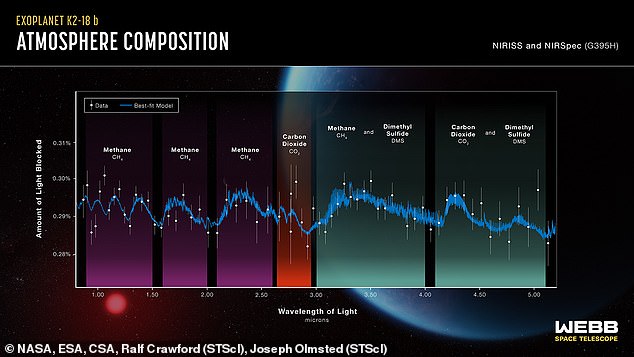
Then, in 2023, the James Webb telescope detected carbon dioxide and methane In terms of its environment, along with an insufficient amount of ammonia — a "highly significant" discovery since it suggests there is a water ocean beneath an atmosphere rich in hydrogen.
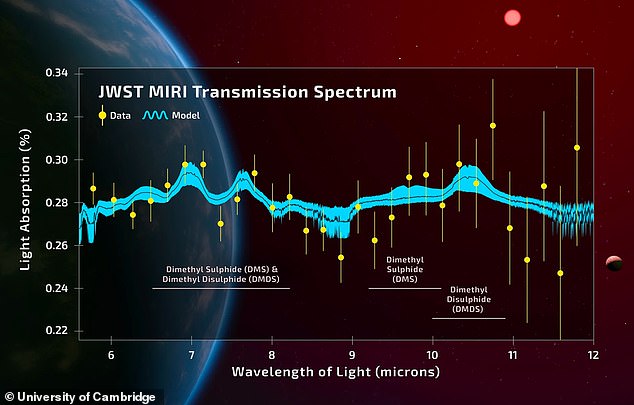
Undoubtedly even more thrilling, nonetheless the finding of dimethyl sulfide (DMS) and dimethyl disulfide (DMDS) within the planet's atmosphere .
On our planet, DMS and DMDS are exclusively created by living organisms, mainly microscopic ones like marine phytoplankton—indicating that a comparable form of life might exist on the far-off world.
Actually, researchers haven't come up with any natural geological or chemical processes that can produce DMS without the presence of living creatures.
Furthermore, the levels of DMS and DMDS in K2-18b’s atmosphere are thought to be immensely higher—exceeding 10 parts per million by volume versus just one part per billion on Earth—which paints a picture of a planet covered in oceans brimming with life.
However, the team 'remain cautious' and want to obtain more data before officially announcing that life has been found on another world.
The findings have attained a 'three-sigma' degree of statistical significance, indicating that there is a 0.3 percent likelihood that they happened randomly.
For an observation to achieve the recognized status of a scientific discovery, it must surpass the five-sigma threshold, indicating that there is less than a 0.00006 percent likelihood of the result happening randomly.
Approximately 16 to 24 hours of additional observing time with the JWST could assist them in achieving the crucial five-sigma significance level.
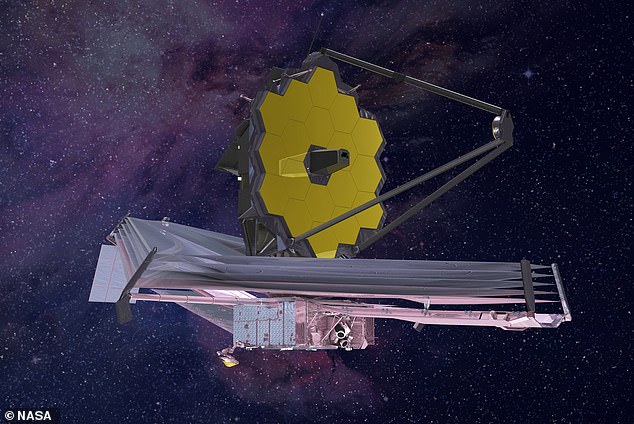
NASA’s $10 billion (£7.4 billion) telescope can examine the chemical composition of a far-off planet by studying the light from its parent star after it travels through the planet’s atmosphere en route to our planet.
Gases within the atmosphere absorb certain portions of starlight, yet each one leaves distinct markers in the spectrum of light.
Astronomers can subsequently assemble these signatures to identify the component gases within the exoplanet’s atmosphere.
The latest findings are outlined in The Astrophysical Journal Letters .
Read more