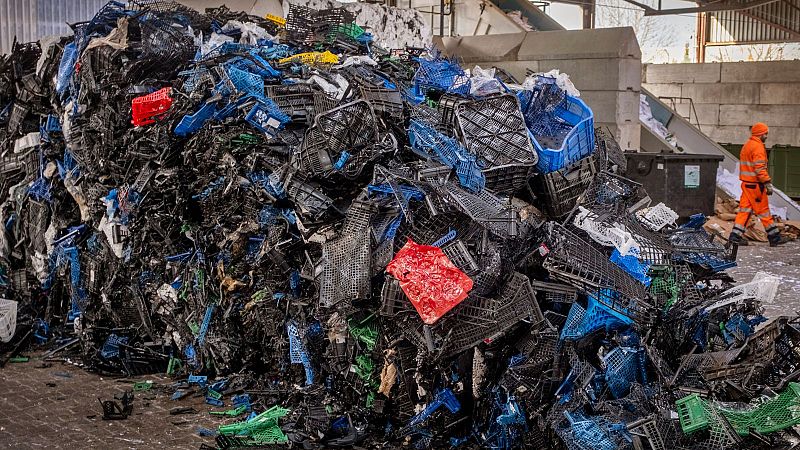
A detailed new research indicates that global plastic recycling rates have stalled below 10 percent.
The production of plastic has surged meanwhile, posing what researchers from Tsinghua University in China describe as a "critical global environmental challenge."
Most plastics are produced using virgin resin sourced from fossil fuels, thereby "undermining global initiatives to combat climate change."
Their discoveries, detailed in the journal Communications Earth & Environment on Thursday, contribute to a limited yet expanding field of study focusing on the origins of plastic contamination across various stages of production and distribution.
An investigation Last month, over 25 significant brands that use plastic packaging were connected to fracking operations in the American Permian Basin — referred to as a 'carbon bomb' due to the severe effect its complete extraction would have on worldwide emission levels.
What percentage of global plastic gets recycled?
To create a first-of-its-kind analysis From the worldwide plastics sector, the researchers relied on national statistics, industry reports, and international databases from 2022.
They discovered that only 9 percent of the 437 million tons of new plastic created that year was derived from recycled sources.
As per authors Quanyin Tan, Khaoula Houssini, and Jinhui Li, the worldwide recycling rate stayed constant [...], indicating minimal progress compared to earlier years.
Noting that the United States, which leads in per capita plastic consumption, has one of the world’s lowest recycling rates at merely 5 percent reuse, they point out. This situation deteriorated further afterwards. China introduced a prohibition on importing plastic waste in 2018.
A transition from landfills to waste incineration
Even though the recycling rate persists at a stagnant 9 percent, there has been a notable change in waste management with a move away from landfills towards incineration.
Landfills Still, they remain the primary destination for plastic waste, accounting for 40 percent, though this proportion has decreased in recent years. Meanwhile, incineration has increased to 34 percent.
Japan, China, and the European Union lead in plastic waste incineration with rates of 70%, 60%, and 38% respectively. For Europe, this trend can be linked to its emphasis on converting waste into energy through various initiatives aimed at recovering energy from refuse.
However, the researchers warn that burning plastics also poses dangers due to the release of hazardous pollutants, which necessitate sophisticated technology and stringent regulations.
Why is such a small amount of plastic being recycled?
Although shoppers segregate their refuse with good intentions, merely 38 million tons out of the 75 million tons of plastic that gets sorted and gathered annually manages to get recycled.
Several elements are hindering plastic Recycling aside, the study elucidates several challenges. Firstly, the vast variety of plastic types complicates their handling during processing. Additionally, contaminants such as food residue and labels hinder effective sorting and cleaning at recycling plants.
Economically speaking, virgin plastic frequently turns out to be more cost-effective compared to recycled plastic, primarily because of varying oil costs. These economics tend to deter investments into recycling facilities and technologies, which keeps recycling levels relatively low.
The researchers also emphasize that more needs to be done during the design phase to guarantee products can be recycled effectively.
Could an international agreement curb the influx of plastics?
Plastic has permeated every aspect of our daily existence, yet it casts a significant ecological shadow throughout its entire lifecycle.
The latest research indicates that approximately 98 percent of the virgin plastics manufactured globally in 2022 were made using fossil fuel-based materials, with 44 percent coming from coal, 40 percent from oil, and 8 percent from natural gas.
To address this significant contributor to emissions and cleanse plastic pollution from our surroundings, the globe is vigorously debating a a legally enforceable agreement concerning plastics .
Negotiations fell apart In December, but scheduled to reconvene in August in Geneva. The researchers express their hope that their comprehensive review of the plastic life cycle will contribute to achieving a favorable result.
“This research further underscores that recycling alone won't solve the issue of plastic contamination," remarks Delphine Lévi Alvarès, the global petrochemical campaigns director at the Center for International Environmental Law, who was not part of this study.
Fundamentally, plastics are just another guise of fossil fuels and play an essential role in sustaining the fossil fuel sector. To tackle both plastic pollution and the climate crisis effectively, the primary and crucial measure is to reduce the manufacturing of new plastics.