- READ MORE: Scientists might have discovered extraterrestrials—but should we make contact with them?
Researchers have astonished everyone by announcing that Life probably exists on a distant world. .
K2-18b – larger than our planet by over double and located at a distance of 120 light-years – resides within the habitable zone around its star in the constellation of Leo.
According to a new University of Cambridge study, its atmosphere contains large amounts of chemicals, which on our planet are solely produced by living beings .
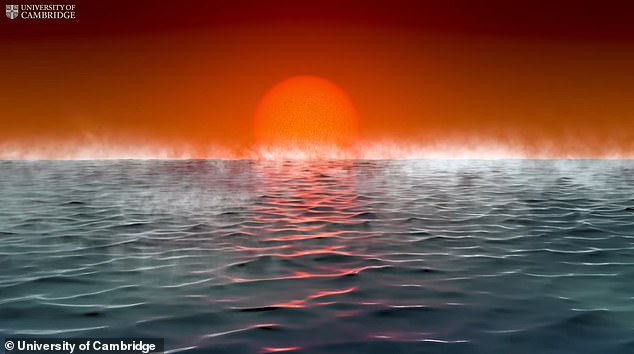
K2-18b is believed to be what scientists call an 'hycean' planet – essentially a celestial body composed of rock but enveloped in an atmosphere rich in hydrogen, with expansive bodies of liquid water.
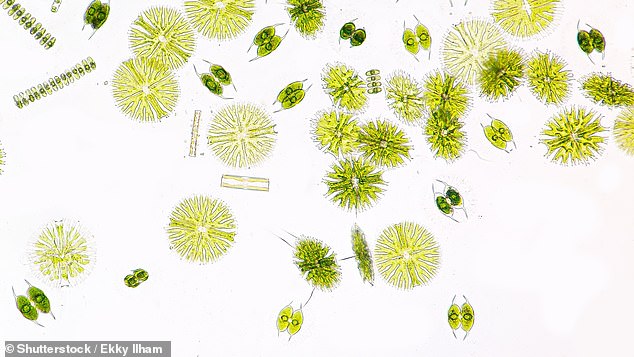
It's probable that The seas of K2-18b contain organisms similar to phytoplankton. – small organisms that derive their energy from the close-by star.
However, what's thrilling is that K2-18b is highly improbable to be a solitary instance in the cosmos—indicating that numerous other planets resembling it probably exist as well.
Peter Vickers, who teaches philosophy of science at Durham University, suggested that there could be 'millions' of planets beyond our galaxy that harbor some form of life.
"If it turns out that K2-18b hosts life, then it’s almost certain that there are millions of additional exoplanets harboring alien life," he stated to MailOnline.
Professor Vickers added: 'A few hundred million is quite a conservative estimate and certainly not exaggerated.'
Planet K2-18b resides within our galaxy, the Milky Way, yet the cosmos houses an estimated billion to trillion other galaxies.
The scholar emphasized that we have only examined an infinitesimally small fraction of the planets within our galaxy, utilizing both space and ground-based observatories.
Therefore, the entire universe most likely contains numerous additional planets with environments suitable for fostering life.
He stated, "It would be akin to randomly scooping with a cup into an ocean and catching a fish, after which you ask yourself if it’s likely that there are many more fish in the sea."
If you believe that biological activity might be present in the far-reaching expanses of space, chances are specialists in this area would concur with your viewpoint.
A survey carried out by Professor Vickers and associates last year indicates that this opinion is widely shared amongst astrobiologists, those scientists dedicated to studying alien life forms.
Of the 521 astrobiologists who participated, 86.6 percent concurred that it is probable extraterrestrial life (at least in a fundamental form) exists somewhere in the cosmos, whereas only about 2 percent disagreed and approximately 12 percent remained indifferent on the matter.
Furthermore, 88.4 percent of non-astrologists concurred, indicating that astrobiologists do not show more bias towards belief in alien life than their fellow scientists from different fields.
'Consequently, we could conclude that there is a strong agreement among us suggesting that some kind of extraterrestrial life exists somewhere beyond our planet,' stated Professor Vickers and his team in an article for The Conversation .
The British science author and biologist Matthew Ridley thinks it would be quite strange if our planet were the sole inhabited world in the entire cosmos.
'Given the scale of the universe, it would be more surprising if life did not exist in it,' he says in today's Daily Mail.
'If life began billions of years ago on other worlds, it’s likely that enough time passed for it to evolve beyond mere microbes and algae, possibly even reaching advanced civilizations with highly intelligent entities.'
Nevertheless, Viscount Ridley suggested that maybe "we should stay silent and not alert the extraterrestrials to our presence" to avoid potential destruction or conquest of our world.
Mark Buchanan, a physicist and science author, believes that numerous additional exoplanets akin to K2-18b likely support comparable forms of life.
'Only over the last ten years or so have our telescopes advanced sufficiently to discover and study planets around distant stars,' Buchanan explained to MailOnline.
'Reliable calculations suggest that the count of possibly habitable planets could be in the hundreds of millions or greater.'
'The cosmos truly is vast, and we have only started uncovering what lies beyond our world.'
Buchanan referred to the recent statement from University of Cambridge researchers as a 'compelling discovery,' indicating that it implies 'the existence of more sophisticated life forms beyond our planet.'
The new findings provide the 'strongest hint yet' of biological activity outside our solar system according to the researchers – although they are yet to be definitively confirmed.
What discoveries have scientists made regarding Planet K2-18b?
Research on planet K2-18b is spearheaded by Dr Nikku Madhusudhan, an astrophysicist from the University of Cambridge. He refers to this exoplanet as a 'hycean' world—a celestial body characterized by its rocky composition and hydrogen-dominated atmosphere along with vast expanses of liquid water.
The planet K2-18b – which has more than eight times the mass of Earth and is over twice its size – was found a decade ago, yet it wasn’t until 2019 that the existence of water vapor within K2-18b's atmosphere was reported.
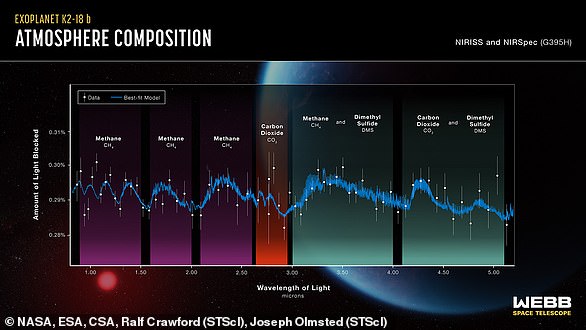
Next, in 2023, the James Webb telescope identified carbon dioxide and methane In terms of its environment, along with an absence of ammonia — a 'highly significant' discovery since it suggests there is a water ocean beneath a predominantly hydrogen atmosphere.
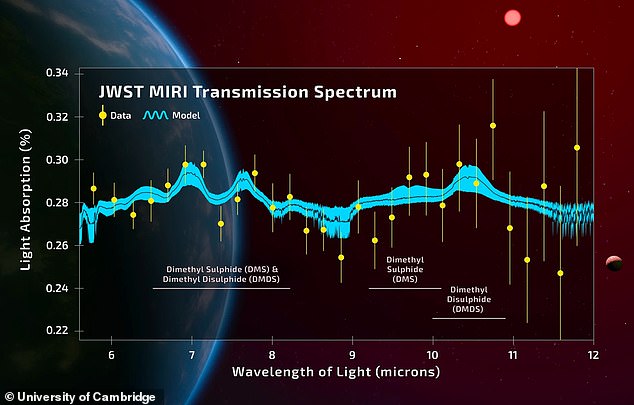
Undoubtedly even more thrilling, nonetheless the finding of dimethyl sulfide (DMS) and dimethyl disulfide (DMDS) within the planet’s atmosphere .
On our planet, DMS and DMDS are exclusively generated by living organisms, mainly microscopic ones like marine phytoplankton—indicating that a comparable form of life might exist on the far-off world.
Actually, researchers haven't managed to come up with any natural geological or chemical processes that can produce DMS without the presence of living creatures.
Furthermore, the levels of DMS and DMDS in K2-18b’s atmosphere are believed to be vastly higher—exceeding 10 parts per million by volume, which contrasts sharply with just one part per billion on Earth, painting a picture of an ocean planet brimming with living organisms.
Nonetheless, the team remains cautious and aims to gather additional data prior to formally declaring that life has been discovered beyond our planet.
The findings have attained a 'three-sigma' degree of statistical significance, indicating that there is a 0.3 percent likelihood that they happened randomly.
For an observation to achieve the recognised status of a scientific discovery, it must surpass the five-sigma threshold. This indicates that there is less than a 0.00006 percent likelihood that the findings happened randomly.
Approximately 16 to 24 hours of additional observing time using the JWST could assist them in achieving the crucial five-sigma significance level.